Advaita

Advaita – Mind Over Reality
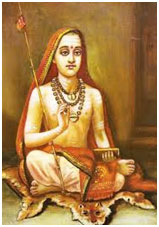
shankaracharyaThe Founders of Advaita Vedanta

Advaita is not so much a spiritual path as a philosophy, a highly intellectualized vision of reality. It has risen to popularity in the West largely due to Ramana Maharishi, a great sage who chose to articulate his self-experience through the philosophy of Advaita, even though he himself did not follow the teachings of Advaita on his path to self-realization. The concept of non-duality, which sits at the heart of Advaita, is very old. It can be found in the ancient Brahma Sutras of Bādarāyana and the teachings of Gaudapada. Gaudapada was GovindaBhagavatpāda’s teacher, and he in turn was Adi Shankara’s guru. However, it was Shankara who, in the 8th century, gave Advaita Vedanta its final, recognizable shape and who became its most influential expounder. Adi Shankara was not a practical teacher, but a religious reformer and philosopher who travelled across the Indian subcontinent to propagate his philosophy through discourses and debates with other thinkers. His objective was to ‘defeat’ Buddhism and Jainism and to revive and purify Hinduism, which at that time was composed of many disparate and conflicting sects. He also wanted to reinstate Hinduism as the main religion in India.

While Shankara was against Buddhism, he was fond of Buddha himself. This is unsurprising, as Buddha’s success as a teacher had impressed many adepts of varying religious allegiances, including the eccentric Hare Krishnas who considered Buddha to be an incarnation of Vishnu. Shankara called Buddha “An emperor of yogis in the Kali age.” This statement, coupled with the fact that Shankara incorporated some Buddhist concepts into his own philosophy, has led many to accuse him of being a ‘Buddhist in disguise.’ But we could just as well say that Buddha was a Hindu in disguise, as many of the main ideas in Buddhism, such as the negative perception of existence and need for ‘moksha’ (liberation), were taken directly from Hinduism.

Shankara was critical of many other paths as well. Among other things, he did not approve of yoga as a means for reaching liberation; while he considered it to be potentially useful as a preparatory practice, he did not see it as a way to gain direct knowledge of the self. In his view, the knowledge of ‘brahman’ manifested from inquiry into the words of the Upanishads, the ancient scriptures that speak of the unity of ‘atman’ and brahman. Shankara’s philosophy is called Advaita Vedanta because it perceives Advaita to be the essence of the Upanishads, otherwise known as ‘Vedanta’, which means ‘the culmination of Vedas.’

The two other influential thinkers who taught Vedanta (but not Advaita) during that era were Madha and Ramanuja. Ramanuja taught ‘qualified non-duality,’ in which atman is considered to be one with brahman but not the same as him. Madha, on the other hand, taught ‘dvaita’, which posited a clear duality between atman and brahman. When these thinkers constructed their arguments, they aimed to prove that their interpretations were the correct exegeses of what was written in the scriptures. For them, the Vedas were the ultimate authority, like the Torah is for orthodox Jews today or the Bible is for Christians. The problem is that most of the scriptures carry equivocal messages which can be interpreted in both dual and non-dual ways; hence all these arguments and intellectual battles can never be resolved. Most of Shankara’s writings were actually commentaries on various ancient texts. It seems that, despite his dry intellectualism, he was deeply devotional and very emotionally attached to the Hindu tradition.

What is Advaita?

Advaita, which means ‘not-two,’ is what is called ‘monism.’ The difference between monism and non-duality is that non-duality is not an affirmation of reality as ‘one,’ but rather a negation of its ‘two-ness.’ The concept of non-duality was created to describe the relationship between atman (soul) and brahman (universal self). brahman is considered to be the substratum of existence without attributes (nirguna). When the world is perceived in separation from brahman, it is called ‘maya’ or illusion. The Hindu metaphor for the veil of illusion is a rope that is mistaken for a snake; when one realizes it is not a snake, one becomes free from fear. In a similar way, when the world is seen as the manifestation of brahman, that world becomes real (it is no longer the snake of maya). To put it simply, there are three stages of realization in Advaita: that brahman is real; that the world is an illusion; that there is only brahman.

In non-duality, atman is not only thought to be one with brahman, but identical to it: atman is brahman – “I am That” (ahambrahmanasmi). All is one, all is brahman. However, to avoid the paradox that the concept of oneness requires its opposite (which is duality), the nature of reality is instead defined in negative terms as non-dual – ‘Advaita.’ To put it simply, the meaning of the non-dual ‘relationship’ between atman and brahman in non-duality is that they are one and the same, meaning there is no relationship at all.

In the Upanishads, atman is compared to the space inside a clay pot. The space inside and outside of the pot are the same, but the illusory walls of the pot make its inner space appear distinct. This false distinction is caused by the illusion of identification with form (rupa). When the pot is broken (the death of the body) those two spaces become one. However, through correct understanding and self-actualization, the realization that the space inside and outside the pot are one can be made without breaking it, meaning within the living body. Here, form is not destroyed, but its identification with a distinct sense of self is dissolved – this is enlightenment. Using this metaphor, we can say that ‘oneness’ signifies that the space inside the pot is inherently one with the space outside the pot, while ‘non-duality’ means that they are ‘not-separate.’ On some level, non-duality represents a deeper level of oneness because duality, as the prerequisite of unity, is entirely by-passed.

Based on this philosophy, Advaita shares the same view of awakening as ‘jnana yoga,’ the yoga of knowledge. It states that, by mental exertion, self-inquiry or internal contemplation, we can realize our true self. We can find similar ideas in Zen, for instance, or in the teaching of Krishnamurti. And while understanding is indeed very important, in itself it has very limited power to produce the event of awakening. Additionally, even if, in an ideal scenario, we manage to trigger the awakening of the state beyond the mind, we are still far from being self-realized. For instance, the realization of pure consciousness is just the beginning of evolution into our complete self. Many traditions imagine that by removing avidya (ignorance), envisioned as the‘dust’ that covers our pure nature, we immediately shift into our perfect and complete self. But nothing could be further from the truth.

We should not forget that the Advaita taught by Shankara was Advaita Vedanta. Nowadays, those who follow a commercialized form of Advaita have little to no knowledge of Vedanta. Can one really be a follower of Advaita without studying the Upanishads? This is a contradiction in terms. Shankara would probably consider such people illiterate and unworthy self-knowledge.

It is actually quite difficult to say exactly what Advaita is, because there are so many variants and interpretations of its philosophy. Whether Ramana Maharishi taught true Advaita is debatable. He was, in fact, teaching his own version of the philosophy of Shankara, mixed with other Hindu teachings. The same applies to Nisargadatta Maharaj – he created his own adaptation of Advaita. Indeed, even during Shankara’s own lifetime there were many disagreements as to the correct readings of Advaita and Vedanta. Our main concern here, however, is not about precisely pinpointing the philosophy of Advaita, but rather extracting its practical applications. How has the concept of non-duality affected our understanding of spiritual evolution and our concept of enlightenment?

What is the Soul and is Atman Real?

When we ask ‘Is atman one with brahman?’ is it really the correct question? Many religions, spiritual paths and philosophies drown in endless speculation about the soul: Is the soul eternal? Is she one with god? And so forth. It is often assumed that the soul is the perfect essence we all have inside, but have we really? To debate whether non-duality, qualified non-duality or strict duality is correct is to seek answers to the wrong question. Why? Because one actually has to have a soul before one can begin to wonder about her relationship with the absolute reality. Initially, the soul cannot be dual, or non-dual, or both dual and non-dual, or neither dual nor non-dual in her relationship to brahman, because she simply does not exist. Nobody is there, just an entirely fragmented psychological self which is barely conscious of its own existence.

So, unless the process of soul-actualization is separated and differentiated from reaching unity with the universal reality, there is no way we can even come close to grasping the nature of spiritual evolution and of the path. Attempting to realize unity or non-duality with universal reality, either by intellectual speculation or self-negation, before we have a real soul to speak of, is a complete misunderstanding. It is also the fundamental flaw in the technology of evolution and self-realization proposed by Advaita.

On some level, the main contribution of Buddhism was to dispel the myth of the soul as our inherent essence and birthright; it cut straight through that ancient superstition. However, the error of Buddhism was to stop at that negation and affirm the absence of self as the universal principle. In truth, nobody has a soul, not because she has no existential existence, but because she has to be actualized in order to exist.

Why did great Advaita masters speak about non-duality as the highest truth, if it is not? There is a naive belief that, if one obtains the enlightened state, by default one also embodies the correct understanding of that state. According to this assumption, an enlightened person would undoubtedly know whether reality is indeed dual or non-dual. But this is not necessarily true. Even if a person does reach a profound inner realization, they can still lack the proper knowledge and requisite level of intelligence to identify the meaning of it. If one is a fool, one is a fool – even self-realization cannot change that. Only when our intelligence truly reflects the nature of the awakened state can we realize awakening and understanding as one. In the majority of cases, they are far from being one. Spiritual intelligence usually lags behind the internal evolution of the soul, simply because it takes many lifetimes to develop. To take Ramana Maharishi as an example, he was in fact highly intelligent, but his views were very conditioned by Hindu spirituality. Living in his profound state of surrender, he simply did not notice that his soul was distinct from the self in which it was constantly absorbed. Perhaps he also did not care to notice, because realizing his higher individuality was not his own deepest desire. Even so, when he pointed to his heart as the seat of the self, it was indeed his soul that he was experiencing.*

The bottom line is that, because past traditions of enlightenment do not include the realization of our higher individuality in their vision, they tend to see enlightenment as a leap from the false self into samadhi in the universal reality: a leap into a radical re-identification with the universal reality. So the assumption is that no one needs to be in samadhi, because there is only brahman, or non-self. But again, how can we reach unity with the pure nature of existence if we do not possess a substantial identity of our own? The answer that Advaita gives is that we are essentially no different from brahman. Therefore, all we need to do is remove the illusion of being separated. Those who find comfort in such concepts have no sensitivity or respect for their inimitable subjectivity. Through the crude logic of non-duality they justify their numbness to their most intimate existence and deny who they are. In the pursuit of an insipid concept of enlightenment, they go against the very purpose of their existence and fail to give birth to their soul. This is how that very ignorance (avidya) they sought to transcend returns through the back door to infiltrate itself into spirituality, in the disguise of soulless ‘enlightenment.’

Advaita – Mind over Reality

What can be appreciated about Advaita is that it was never institutionalized; it has never become a religion. Though based on the study of the Upanishads, it was originally a pathless path which pointed directly to reality. The down side of this is that it became extremely impractical; it did not offer any tangible tools on how to achieve these deep realizations. As a result of the fact adepts of Advaita could not experientially actualize the essence of Vedanta just by studying scriptures or doing self-inquiry, the figure of the guru gradually came to be elevated to the position of the one who bestows the magic of enlightenment. Without the master’s grace, the path of Advaita is nothing more than a mental construct: the fantasy of understanding of something that can never be attained.

Advaita gives the illusion of being logical, of using logical arguments to convince the mind that reality is non-dual. However, the linear logic of the mind cannot even begin to reflect the nature of reality. It is just the mind talking to itself. The truly trans-linear logic of reality can only arise from the soul, from our deeper consciousness. This ‘logic’ is intuitive and capable of sensing and feeling the most subtle dimensions of our existence. The logic of Advaita is not the language of the soul – it is the language of the mind.

The function of the mind is to reflect in our intelligence the journey into the soul. But there is a point where, instead of reflecting and articulating truth, the mind begins imposing its own ideas on reality. This is the point where we lose our objectivity, our higher perspective and connection to the facts of existence. We begin to live in the world of the mind, in a world created from thoughts alone. Our soul is captured, imprisoned in the net of conceptual reality. She is no longer free, and in the claustrophobia of this mental cage, she begins to wither, dying away into sadness.

There is religion, philosophy, and spirituality. Out of these three, spirituality is the highest. When religion controls spirituality, it kills it. When philosophy controls spirituality, it kills it. Religion must step down if it has any respect for truth, while philosophy must learn to serve spirituality, otherwise it becomes its very enemy. Advaita is unique in the sense that it appeals to our responsibility to find a direct insight into our original nature through the power of intelligence and understanding. However, somewhere along the way, due to its addiction to linear logic and idealism, it has become disconnected from truth. It has come to represent more how our mind works than to reflect reality. Advaita is an expression of extreme spiritual intellectualism which has chained our spirit and creative intelligence to non-dual dogma, blocking us from discovering the living truth of higher duality.

Falling into its own Trap: Further Flaws of Advaita

Even within its own limitations, is Advaita really logical? The fact is that there cannot be non-duality without duality, because to say ‘atman is brahman’ we need duality. Non-duality is only one aspect of reality and, the moment we make this one aspect absolute, it ceases to be truth at all – it becomes a lie. By denying the duality between the soul and her creator, not only is Advaita repudiating their relationship, it is also rejecting the relationship between the soul and her own subjectivity. And because that innermost and most fundamental relationship within our individual subjectivity is denied, the arising of true self-knowledge becomes impossible. Even though self-knowledge is meant to be its essence, Advaita is not a path of self-knowledge. It is a path of self-denial justified by identification with impersonal existence. People who abide upon the concept of non-duality, in a similar way as those who cling to the concept of no-self, not only do not know who they are, they have also entirely stopped looking.

Moreover, due to the fact that the inherent dynamics in the twofold relationship between the soul and herself and the soul and the beyond is negated in Advaita, the nature of the awakening process is not understood at all. We cannot understand our evolution if we do not know who is evolving. Advaita’s version of the concept of sudden awakening is flat and one-dimensional. The complexity of the path cannot be grasped, and the many stages inherent to awakening are not only not explained, they are even denied. This is the problem: If there is no duality how can there be ‘stages’ of awakening? How can there be enlightenment at all? By blindly following the simplistic logic of non-duality, Advaita fell into its own trap. The mind has replaced reality and hypocrisy has replaced freedom.

To deny our individuality is to deny the very thing that makes us human. Even on the path of transcendence, our humanity has to be embraced as the very vehicle of our transformation. Beautiful concepts of devotion and surrender have been distorted and corrupted by the virus of self-negation. Surrender is not self-negation, it is a higher and exalted self-affirmation realized in the context of unity with the universal reality. We do not surrender to vanquish ourselves and vanish, but to enter our greater existence, our true life in the heart of the beloved of all souls, the supreme container of all life forms that is – love.

As a final point, Advaita is often associated with the fatalistic perception of reality and denial of free will found in Hinduism. In the Bhagavad Gita, it is said that one should give up the illusion of being a doer and identify with the ‘witness’. Why has such a perception of reality arisen? If we look into it more deeply, we can discern that it is a direct result of the absence of the concept of integration between our pure nature and its relative human expression. The concept of integration between the absolute and relative can be found in Zen (such as in the Five Ranks of Zen Tozan). But due to its complete negation of our relative identity, Advaita obviously lacks it. The result of this is the idealization of an entirely passive vision of our participation in life which is static, lethargic and non-imaginative. Of course there is no free will for those who are not in touch with their individuality and creativity. Free will and taking responsibility for the actualization of our destiny is an expression of the evolution of me and the awakening of intelligence.

Can Advaita be Saved?

While Advaita’s vision (vidya) of reality is incorrect, we should not fully refute it as ignorance (avidya) because it does contain many important revelations. Instead, we need to look carefully into the basket of Advaita and separate the good apples from the bad. It is difficult to repair the whole edifice if its foundations are flawed, but within the limitations of Advaita, an attempt can be made to rectify it. In this way, those who wish to walk the path of Advaita can endeavor to make sense of it. As Ramana once said: ‘Advaita is correct but only in theory, not in practice. If one followed Advaita to the letter, one could not engage in meditation work because this requires duality.’

The following statements qualify the philosophical assumptions of Advaita and, in doing so, put it into an acceptable conceptual framework:

  1. Advaita is not a path but a final vision of reality. Therefore, after self-realization, the personal self is dissolved in brahman and there is only one self.
  2. On the relative level, however, there is duality between the personal and the impersonal. As in Nagarjuna’s second negation* If this type of duality were non-existent, there wouldn’t be a need for self-inquiry, studying the Upanishads or devotion to Shiva. In fact, even the event of enlightenment presupposes duality. If it is non-duality that needs to be realized, it presupposes one begins in the duality between ignorance and enlightenment. To refute the occurrence of enlightenment at all (as extreme adherents of Advaita do) goes entirely against basic common sense and is foolish. Duality is required even to refute the need for enlightenment.
  3. Any sage who consciously follows the process of realizing non-duality should easily discover it is not black and white, and that there are many levels and stages inherent to self-realization. This indicates that between plain duality and pure non-duality there are intermediary steps, or twilight zones. The evolution into the complete realization of non-duality presumes the presence of a different, more refined, duality as the passage to complete non-duality.
  4. After that which was dual is dissolved, and pure non-duality is realized, we are still caught in the paradox that there was once ‘someone’ who lived in ignorance. Even if we call this ignorance ‘unreal,’ that unreality cannot be entirely refuted, as it did exist at some point of time. Additionally, it still exists for those who are not yet liberated. As is expressed in the Buddhist Diamond Sutra, we need to reconcile the attainment of non-attainment. It may appear inexplicable but can be somewhat rationalized by the concept of a lower truth (which Advaita lacks).

When Advaita is seen as the absolute truth it is avidya in the sense that it is ignorant of the one who reaches non-duality. And if it ceased to be ignorant of this matter, it would not necessarily cease to be non-dual. It would, rather, transform its perception of reality into a more dynamic vision which could embrace both dual and non-dual aspects of existence.

Many seekers of truth are attached to Advaita because they associate it with Ramana Maharishi or Nisargadatta Maharaj. However, as we have said, these two masters did not teach Advaita Vedanta, but their own eclectic version of various Hindu teachings. Of course, they were both aware of Advaita, and they did at times use its ideas to justify their own philosophies. However, to say that they actually taught Advaita is a great over-simplification. They both cared more about the practical truth than the conceptual rationalization of the path. Since they attracted many intellectually oriented Indian and Western followers, they had to speak through the conditionings of these disciples to give some food to their minds, but this does not make them teachers of Advaita. Who are the real teachers of Advaita? With the exception of Adi Shankara, there really have not been Advaita teachers, only Advaita philosophers. No respectable teacher would teach Advaita, because it defies the fundamental principles of the inherently dual path to enlightenment.

Advaita may be valuable and beautiful, but more in the way the Egyptian pyramids have value – as relics of a golden era – rather than as something which can be applied directly to our immediate problems. The efforts of these deep thinkers, who wholeheartedly attempted to unravel the mystery of human enlightenment by using their linear mind to its very limits, can be deeply appreciated. But it is truth and not sentimentalism that we serve. Based on truth and compassion for those seekers who walk the path in deep pain and longing for freedom, we must conclude that Advaita is, in its current form, a reflection of ignorance. Those who surrender to Advaita without revising its fundamental assumptions, are either unintelligent, dishonest, or insincere. If they cannot embrace the essential duality between their own selves and universal reality, they should not enter the spiritual path in the first place – they are not ready.

Blessings, Aadi

For a definition of the terminology used, please visit the Glossary page. Click here for a printable version of this article.


Advaita of the Hollow Men

advaita2

We are the hollow men We are the stuffed men Leaning together Headpiece filled with straw. Alas! Our dried voices, when We whisper together Are quiet and meaningless…

This is the way the world ends This is the way the world ends This is the way the world ends Not with a bang but a whimper

– T. S. Eliot

The devil’s apprentice comes to his master, terrified to report to him that the first man has become enlightened. Soon, the apprentice feared, they would be out of business. The devil said “Don’t worry. We will use enlightenment to our own ends, and we will prosper.” Unfortunately, the devil seemed to understand humanity quite well.

Modern day Advaita, through the personas of a proliferation of so-called spiritual teachers, is spreading the good news of instant enlightenment. This is clear confirmation that the devil has done his work – and succeeded. The increasing popularity of Advaita within the less discriminative masses of humanity is a flowering of mediocrity. It is not that there ever was a time when humanity was not mediocre. It is that mediocrity has become elevated to the position of defining itself through the concept of enlightenment and non-duality. This is the tsunami of fake spirituality that proudly waves the flag of Advaita.

Those who possess a basic level of discrimination and common sense have begun to speak about the recent ‘decline of Advaita.’ This statement is worth questioning. Was there ever a ‘rise’ of Advaita, a golden age? Certainly, if we compare the ridiculousness of today’s satsang culture with the teachings of great sages such as Ramana Maharshi, there is a monumental difference. But this comparison isn’t so relevant, because Ramana was unique; he was an exceptional individual who represented his own self more than he represented Advaita per se. With the exception of such isolated cases, where great beings expressed themselves using the language and concepts that Advaita provided, there never really was a golden age of Advaita. In any case, whether or not it represents a decline, the current voice of Advaita is naive and superficial. While a few very high caliber teachers used Advaita to articulate their profound experiences in the past, now people talk about it without even having a shallow realization of its essence.

Advaita was mostly popularized in the West as a result of the influence of Ramana Maharshi, whose teaching managed to reach many Western seekers. However, the boom of neo-advaita teachings has happened after the death of Poonjaji, who during his lifetime, had gathered a great number of enthusiastic but confused and often insincere western students around him. Poonjaji is popularly considered to be Ramana’s successor, but Ramana did not have any successors, and in truth Poonjaji only spent a few weeks with the Maharishi in total.

Even though Poonjaji explicitly stated that none of his disciples had reached enlightenment, many began to claim they were awakened once he had passed away. After the first figure emerged, many more followed. As time went on, and he was no longer there to expose them, the number of people teaching in the name of Poonjaji kept multiplying. The environment that grew out of this – a combination of satsang hysteria, advaita instant-enlightenment brainwashing and the deep insincerity of this group of western seekers – proved to be very unhealthy. The line between following an actual spiritual path and egomania, ignorance, even insanity, quickly became blurred. Individuals with little to no experience of their pure nature began to put themselves in the position of teachers, using Poonjaji’s name to promote their own ego. Some people have called this scene ‘neo-advaita’ in an attempt to forget what it in fact is – the epitomy of stupidity. All these events seem to represent the final fall of the ancient teachings of the Upanishads and of Adi Shankara, as they moved west and lost their sacred essence.

On some level Poonjaji can be held partially responsible for initiating the proliferation of neo-advaita. The fact that he did not have the conceptual tools to differentiate between partial awakening and actual enlightenment created a lot of confusion among his disciples. So, after his death, many of his followers seized the opportunity to claim enlightenment based on various ambiguous hints that Poonjaji may or may not have given. The combination of not having a full understanding of the awakening process and opening to teach western seekers, whom he did not really understand, escalated into an atmosphere of increasing misunderstanding hinging around a diluted concept of enlightenment.

The second, lesser known ‘school’ of neo-Advaita was connected to Nisargadatta Maharaj. He, too, did not officially approve the enlightenment of any of his followers, with the single exception of Maurice Frydman, who is known for having compiled Maharaj’s famous book I Am That. According to Maharaj, however, Frydman was already self-realized before they met. Considering this, it is interesting that Frydman himself claimed that only upon meeting Maharaj had he found true and abiding peace. If he was already realized, why had he not yet found abiding peace? This is rather off-topic, and deserves a separate exploration. Suffice to say that to understand this paradox is to understand the true complexity of human enlightenment – something which is so evidently missing from this ‘pseudo-advaita’ trend. Other than Frydman, Maharaj had only a handful of students. As often happens, he became more widely known only after his death. He was a great being, very dynamic and rather eccentric. Although he was not very educated, he developed his own unique version of Advaita based on extreme disidentification, in which even pure consciousness is seen as a limitation which needs to be transcended.

After Maharaj died, Ramesh Balsekar began to teach in his name. But the true message of Maharaj’s teaching had clearly eluded him. Instead, Balsekar created an entirely intellectual version of Advaita. As we have explored elsewhere, Advaita is already highly intellectualized; Balsekar multiplied this by ten at least. His teaching of non-duality was all about semantics: ‘there is no witness only witnessing,’ ‘there is no doer, all is happening in consciousness,’ and so forth. People were travelling to Bombay from all over India and beyond to listen to him, believing themselves to be on a spiritual path.

All that clever-sounding talk about consciousness is not even true. If things were merely ‘happening’ in consciousness, it would indicate that we are in trouble. Nothing is just ‘happening’; it is happening because everything is interconnected, within a dynamic relationship with the complex organism of life. We are not merely witnessing what is happening in consciousness – that would be ridiculous. In fact, every single act of perception or recognition requires the involvement of our whole being, and consciousness cannot recognize anything without going through the channel of me. Moreover, to say that we are not ‘doers’ is only half of truth. When we take this half to be the whole, that truth becomes a lie. We are doers and we are non-doers. We are co-creators in consciousness and existence; consciousness is a creative process, not a spectacle of puppetry. Everything is ‘just happening’ to those who have not taken control of their lives and destiny, and who are not in control of their own minds. We should feel sorry for those to whom reality is ‘just happening,’ for they have not yet started to live. And although they have not started to live – they have started to teach Advaita.

Advaita has become more and more diluted, like weak wine that was once strong and potent, but is now just pale, colored water. Most of those who teach Advaita and pretend to be gurus are simply very inane and insincere. Why are seekers not more discriminative and intelligent? Why do they flock like sheep to all of these satsangs? Is it because they are naive and don’t know any better, or is there a deeper problem? What is the problem with humanity? Is all this just indicative of the fakeness, mediocrity and hollowness of the collectively fabricated human?

The path to self-realization is not for everybody. In fact, most humans need first of all to evolve exclusively in the psychological dimension, where they can learn how to express their human nature in a positive way and learn how to love. Before we can step into the realm of I am, our me has to reach the requisite levels of maturity and integrity. If we do decide to enter the inner path, we must have our hearts in the right place, or it is better to take a step back. Otherwise, through making these types of life choices, many seekers end up worse than they were before. They become imbalanced, ungrounded, disconnected from normality and lost in mystical states. If we wish to avoid these pitfalls and truly evolve and grow, the essential qualities of character are required. We must be smart, sensitive, critical and watchful of various snares on the inner way. We must know how to distinguish true progress from imaginary awakening and spiritual games. We must be real and seek truth above all else. We must walk the path from our existence with the clear purpose of becoming whole, so that we do not get lost in spiritual experiences or look for affirmation from our egos. The path is designed for those who have the capacity to go beyond their lower identity; it is a process of deep surrender into our soul and of disappearance in the beyond – from which place we can finally embody our universal individuality.

One of the main dangers of present day Advaita is that it introduces overly simplified and distorted concepts of enlightenment and non-duality. The ignorant statement that ‘we are all awakened’ crudely confuses the concept of original enlightenment with acquired enlightenment. It completely fails to see the basic distinction between the idea that all beings are originally endowed with their pure nature and the empirical fact that we have to realize it in order to experience it. We do not realize our pure nature by convincing ourselves that we are all Buddhas anyway, but through a very subtle and complex process of self-actualization. Most adepts of these Advaita movements do not meditate at all, or sit in false devotion at the feet of their ‘gurus’, hoping for a miracle. There is no spiritual practice here, but rather a form of non-dual hypnosis, where the mind, through constant repetition, programs itself with fixed ideas about reality. The mind then confuses this hypnotic psychological condition with actual self-realization. When a beggar is fully convinced he is a king, does it make him a king? Perhaps in his own mind, but not in reality. In reality he is now both a beggar and a fool.

Shallow Advaita needs a shallow audience to reproduce itself in the collective mind. If we want to heal the disease of superficiality in human spirituality, we must start with the very foundation of those who seek evolution. It is the aspirant on the path who must awaken to the higher truth of the spiritual dimension and begin to serve the purpose of his very existence. The moment he sells his soul for the promise of cheap, imagined enlightenment, he becomes responsible for the downfall of spirituality. While neo-advaita is Advaita at its corrupted worst, Advaita was always incomplete: it failed to embrace the dynamic nature of existence and consciousness. The only difference between pseudo-advaita of the past and its present manifestations is that it is no longer even geared toward self-realization. It has become a game of programming the mind with the illusion it is awakened.

Blessings, Aadi

For a definition of the terminology used, please visit the Glossary page. Click here for a printable version of this article.

Neo-Adviata – Deception of Imaginary Awakening

advatia1Neo-advaita can be defined as Advaita for the masses. Its oversimplifications allow people with low intelligence and minimal spiritual aspirations to relate to the ideas of non-duality and awakening. At the heart of neo-advaita is the concept of ‘instant enlightenment.’ Instant enlightenment is a distorted and ignorant misrepresentation of the notion of sudden awakening which has been indiscriminately taken from the original schools of enlightenment. It is an exceedingly superficial interpretation of the spiritual path which combines psychological relaxation with developing a connection to so-called ‘now,’ and then calls the result ‘awakening.’ When the masters of old said: “there is nothing to do, nothing to seek and nothing to reach – our pure nature is already present,” they were speaking in metaphors which point to reality; these were not supposed to be factual descriptions of truth. Neo-advaita has taken these metaphors out of their original context – the holistic inner path – and in so doing, has made an unconscious mockery of this ancient wisdom.
The concept of sudden awakening is that there are no stages to the process of gaining insight into our pure nature; either we know it or we do not. In truth, sudden awakening is not in conflict with the principles of practice and gradual cultivation. On the contrary, to remove sudden awakening from the context of our gradual evolution renders it absurd. The purpose of practice is twofold: firstly, to mature to the point at which a sudden awakening can happen, and secondly, to work toward the stabilization and integration of the newly awakened state. The idea of sudden awakening can be understood in the context of the relationship between original and acquired enlightenment. Original enlightenment signifies that we all carry the seed of our pure nature, while acquired enlightenment points to the fact that this seed is initially dormant – we need to actualize it. This at least is the chain of reasoning in the more sophisticated schools of the non-dual tradition. In reality, original enlightenment does not represent our own pure nature, but the pure nature of the universal reality. To reach enlightenment, then, is to realize both the pure nature of existence (universal self-realization) and to actualize the pure nature of our soul (individual self-realization).

Those who teach that enlightenment as something very simple and accessible to anyone, without the need to go through the process of hard inner work and deep transformation, bring shame on spirituality. They caricature enlightenment, and make it into a joke that is far from funny. Sadly, the current spiritual scene is saturated with teachers and teachings of this kind. They are mostly outshoots of Advaita, whether they link themselves to it consciously or not. These teachings thrive on a shallow interpretation of non-duality, and because such concepts can circulate so freely and abundantly through the internet under the auspices of New Age, pseudo-Zen or therapeutic movements, no one really even knows where they originated.

While it wears many disguises, the concept of instant enlightenment boils down to the idea that we are ‘already awakened,’ therefore, there is no need for practice – it is enough to look inside and recognize our pure nature to ‘wake up’ and be enlightened. It is basically a psychological approach to meditation which aims to ease the excessive mental suffering of western seekers. Its purpose is to reach the condition of calm in the mind through distancing ourselves from our thoughts and inducing a hypnotic state of pseudo-awareness. This hypnotic state is produced by the constant mental repetition of advaitic notions about reality, that ‘all is consciousness,’ or ‘we are not the mind,’ or ‘there is nothing to do or to reach.’ This kind of non-dual programming of the mind in conjunction with the emotional stimulation coming from ‘devotion’ to a guru, releases various chemicals in the brain that create a false affirmation of being awakened. There are shades of grey of course, but we’re referring here to any teaching that simplifies the nature of the spiritual unfoldment to the point of being ridiculous, thereby negating the long, rich path of evolutionary steps that stand between ignorance and self-realization.

Due to the fact that seekers are not being equipped with the tools and concepts which can empower them to take their evolution into their own hands, by default it all becomes about the grace of the guru – guru worship and guru dependence. This imbalance of power between teacher and student results in an unhealthy projection upon the teacher, where adepts put them on pedestals and, in their minds, endow them with magical grandeur and exaggerated significance. Their teachers seem willing to play this game. While they may speak of the need for independence, the whole arrangement forces seekers to become entirely dependent on them, like spiritual slaves. Sitting on the podium as the bestowers of grace, they project an unnatural persona of someone apparently immersed in love and bliss.

Teachers like these, who do not have even a basic knowledge about the spiritual path, have become standard-bearers of the contemporary paradigm for enlightenment. Why is this? Why do so many people applaud this pretend and inherently shallow representation of spirituality? It suggests they are satisfied with a low level of evolution, and wish to just relax, be lulled into a comfortable place inside and be at peace with their misery, rather than standing up, rebelling and fighting against it. Nothing has really changed since we lived in caves – we would rather be numb and survive than be alive enough to challenge the prison of ignorance we are living in.

What are these instant enlightenment teachings about? They are about making ignorance comfortable. Their purpose is to relax and make palatable our fundamental unawareness of who we truly are, and then to introduce the outrageous idea that this is enlightenment. It is fine to help people to relax, to find some stillness in the chaos and pain of their lives, but why use the word enlightenment? This word should not be used in vain. We need to have some respect for the great sacrifices and unimaginable hardships of those who paved the genuine path to self-realization. Others who use this word so freely should think twice before broadcasting their unconscious versions of spirituality. That is respect, and that is truth.

Are There any Benefits to Neo-advaita?

What experiences do neo-advaita satsangs give rise to which may be mistaken for awakening? One explanation is that sitting in a hypnotic way can cause one to experience various mystical states. Mystical states are a very murky area. They are altered states of consciousness that lack clarity and true solidity, but can feel high or exciting. In many ways these states often give a high similar to drugs. Because the experiences of them feels so different to our ordinary mind, someone who does not have the proper perspective and knowledge may easily confuse them with the correct realization.

There is also a small chance of experiencing a real awakening (through the combination of meditation and grace) on such a path. But here we are not looking for miraculous cases, but trying to find a logical link between a path and its most likely outcome. As was noted, the constant repetition of Advaita concepts changes the chemistry of the brain, actually altering how it thinks and perceives reality. An undeveloped mind can become convinced that such an condition really is enlightenment. On a ‘higher’ level, one might also experience something deeper than the mere intellectual conviction of being self-realized, but find it difficult to pinpoint exactly what it is. It is neither consciousness nor awareness, but rather a subconscious state of me that abides in a nether land of ‘neither here nor there.’

Perhaps the neo-advaita satsang movement has its place, but it must be seen in the right perspective. First of all, people should stop seeing it as a path of self-realization or enlightenment – it is not. Secondly, neo-advaita teachers should not be seen as gurus, but as therapists who apply the basic concepts of spirituality and meditation to help alleviate people’s distress, depression and chaos of mind. This should be based on a combination of gentle self-inquiry and basic meditation-relaxation techniques, which in a shallow way, can open the space beyond thought. This process should be supported by the development of mindfulness and clarity, so as to avoid falling into mystical states, which can be a major pitfall with these types of practices. In this way perhaps these teachings could really help some people in their first steps to becoming more conscious.

A key question is whether neo-advaita can be separated from the non-dual mind conditioning inherent to it. At the end of the day, this conditioning is simply harmful, as it distorts the true picture of reality and prevents the dawning of real self-knowledge based on embodying our higher individuality. Additionally, it is difficult to imagine neo-advaita outside of the context of guru-projections, because such projections are what serve as the axle for its mental programming and the resulting outcomes. Without being able to induce that hypnotic state of mind, neo-advaita would die a natural death because people would realize it actually has nothing to offer, that they have been deceived. So, while acknowledging its modest therapeutic and contemplative benefits, the fact remains that neo-advaita is not a solution for our suffering and sadness, no more than opium or alcohol are. Those who walk this path should begin to question their intentions and motives. To seek a way out of suffering by inducing an artificial affirmation of being awakened is not only very unintelligent and insincere – it blocks our further evolution and closes the door to true freedom. If we fail to follow truth due to our impurity and lower intention we will sooner or later have to pay the price – the inconsolable pain of being completely lost.

Blessings, Aadi

For a definition of the terminology used, please visit the Glossary page. Click here for a printable version of this article.

Maharshi and Maharaj – Acme and Ending of Advaita

Ramana Maharishi

maharshi1

No one succeeds without effort… Those who succeed owe their success to perseverance. –Ramana Maharshi

Ramana Maharshi was one of the greatest sages of all time. We say this not so much because of his teachings, but because he was such a highly realized and evolved soul. He entered the path at an early age due to a profound and spontaneous shift in consciousness. Later, he described his awakening as having occurred through intense self-inquiry, in which he visualized that his body had died. However, this inquiry was more a post-awakening rationalization of his inner transformation than its catalyst or cause. Due to this misrendering of events, Maharshi put too much emphasis on self-inquiry later on in his life, wrongly assuming that it could manifest the same kind of awakening in others.

Self-Inquiry – the True Path of Maharshi?

A great number of seekers since have imagined that by following the practice of ‘vichara’ (self-inquiry) they were walking the path laid by Ramana. But were they getting any closer to their true self? Asking oneself ‘Who am I?’ does not constitute a spiritual practice in itself. The true meaning of self-inquiry is to turn consciousness back on itself and directly recognize the essence of pure subjectivity. One cannot unveil the answer to this question through the power of the mind: it is the act of a single instant of pure cognition which is performed by a much deeper faculty than the ‘thinker’. Taken out of this context, self-inquiry can quickly become a mind game, a form of procrastination and avoidance of meeting one’s essential self. Additionally, even if one does inquire correctly, one already needs to have access to the state beyond the mind. Otherwise, who is recognizing who? The answer to this question is not waiting like a forgotten object, needing to be brought into consciousness through our attention – it must be activated through a deep spiritual shift. Awakening is not merely an act of recognition, it is a dimensional leap into our future self. And for that to happen, the doorway to I am has first to be opened. Without that opening, self-inquiry is the wrong practice.

We can discern through his writings that Ramana did not really know how he arrived at his own realization, and this is actually a common story among spiritual masters. The paths they create for their followers are retrospective attempts to rationalize their own paths, paths they did not fully understand as they were unfolding. Ramana oversimplified his path by assuming that, in his initial spontaneous awakening, he had reached complete self-realization. He never expressed this directly in words but he did imply it indirectly. In reality, however, he only became complete after many years of meditation and integration. As a young man, he lived a life of extreme absorption, neglecting his basic human needs. During that time, neither his mind nor his energy were fully balanced. He was intoxicated with the divine, hovering between the shores of enlightenment and madness. He was on his path, his journey, and to think that he was already complete from the beginning is very naive.

He did say once that, from his awakening as a boy right through to his old age, there was the common thread of that which does not change. This is true of the spiritual path – from our entry right through to completion, we carry the thread of the essence of pure subjectivity. But for that essence to become a complete soul, many elements need to fall into the right place. When the seed of a tree is planted, its essence is naturally incorporated into the tree it grows into. However, for the tree to become mature, it has to pass through many long seasons. To confuse Ramana’s initial awakening with his complete enlightenment is to confuse the seed with the great tree it eventually becomes.

Limitations of Ramana’s Path

Ramana was a beautiful being, loving and compassionate and as a teacher, free from any traces of promoting a personal agenda. It is also true to say that he did not experience a normal human life, he did not live in society, pursue any ambitions or seek emotional fulfillment. He tended to avoid any confrontations within ashram life, which may have been due to an accepting attitude or to a type of avoidance of those human dilemmas. It’s interesting to wonder how a person who lived a life of such extreme renunciation could ever understand what it means to be human, or indeed, ever understand other humans. This was the journey he chose, and that is to be respected. However, it is important to see its limitations as well. His contribution to human spirituality was incomparable, but ironically, he could not really understand what it means to be human, because he never lived or developed as one himself, with all the challenges and experiences such a life entails.

As was noted, Ramana taught the path of self-inquiry. But did he really? What was Ramana’s real teaching? He was astute, and he no doubt noticed that none of his devotees were coming any closer to awakening through the practice of vichara. Perhaps he gave them this practice more to keep them busy than to lead them toward a true awakening. There is nothing particularly harmful in self-inquiry, and when it is done in moderation, it can support the maturation of our spiritual intelligence. But in the end, it was not self-inquiry but his powerful presence in conjunction with sitting in meditation that facilitated spiritual progress among his followers.

Ramana’s model of awakening was quite simple, although it did seem to oscillate as time went on. At times he appeared to be teaching a form of sudden enlightenment, while at other times he spoke of its gradual stages. For instance, he differentiated between ‘sahajanirvikalpa samadhi’ and ‘kevalanirvikalpa samadhi’; in the latter, one has access to – but is not fully established in – the self, while in the former, the state is permanent and integrated. He also spoke about an evolutionary curve in which the self is first realized in the head and then drops into the heart. He was not particularly interested in elaborating on the apparent contradiction between the sudden and gradual approaches to enlightenment. We must remember that he was not conscious of all the steps in his own intricate process of completion: most of his evolution happened naturally and spontaneously while he was immersed in samadhi for all those years.

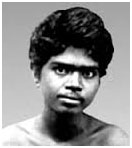
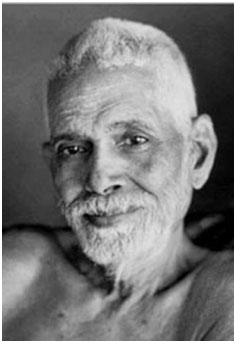
maharshi2When you look at photos of Ramana when he was young, you can see that all his energy is in his head. There is also an excessive intensity in his eyes, which is an indication of abiding in an unnatural or mystical state. Over time, this intensity dissipated and his eyes came to embody a condition of rest and calm. You can also perceive a sense of alienation in his eyes, coming from his total withdrawal into the inner realm. As his evolution continued, his energy gradually dropped into his heart, which he called the seat of the self (interestingly, he experienced his heart on the right side of the chest, whereas the spiritual heart for a human soul is located in the middle. This is most likely due to certain predispositions that he developed in former lifetimes). Ramana sat in meditation all of his life and as such developed a natural connection to being. Also, while his energy dropped from the head into both the heart and being, his heart was eventually established as the focal point of his existence. So it is clear he was evolving. In Advaita, the concept is that once enlightenment is reached it is complete because any further evolution would imply imperfection, and hence duality. But this, as we have established elsewhere, is far from the truth.
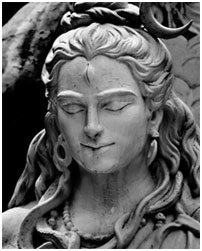
Ramana was living in samadhi, not only when he sat in meditation, but at all times. He didn’t have the conceptual tools to explain his state, but in our terminology we would say it was a combination of consciousness, heart and being. While he was not on the path of the absolute state, the depth of being he reached was enough to absorb his consciousness and heart into the state of absence. Because of the greatness of his soul, by the end of his life he did become whole and complete, despite having completely disregarded his human nature and individuality. And although he did become whole, he did not teach a path to wholeness, but rather a path to transcendence. He was a pure channel of Shiva and the last true teacher of Advaita, a spiritual titan amongst men. He will forever be remembered as the embodiment of the highest spiritual potential of humankind.

Having said this, to follow his teaching without his direct presence does not offer a clear path of evolution. While he did insist on the practice of sitting meditation, he did not clearly explain what meditation really is or how to cultivate the inner states. So he was not a meditation teacher. His concept of transforming thinking was to ‘kill the mind’ and to ‘kill the ego’, an approach which not only does not work, but prevents any possibility for the positive transformation of our human self.

The limitations of his teaching can be simplified and summarized as follows: lack of the knowledge of me (not just its multidimensional nature, but even a basic insight to what our me really is); denial of our individuality with the resulting extreme identification with the impersonal; lack of distinction between awareness and consciousness; incomplete vision of vertical evolution (other than consciousness dropping to the heart); lack of embracing our human existence or a conceptual vision of how to integrate it with our higher self; simplistic and one-dimensional concept of the mind (in which an understanding of how consciousness and thinking coexist was entirely absent); and last but not least, an absence of the concept of soul, our higher individual self. Ironically, while he based his teaching on self-inquiry, he failed to give an accurate answer to the question ‘Who am I?’. He plunged into the realm of the universal I am, but he did not acknowledge his soul as the subject of unity with the self. This is what we call the confusion or displacement of identity.

Ramana taught through his grace and the grace of Shiva. Ultimately, it was his presence which transformed his devotees. It was his continuous absorption in the self, his love and uncompromising representation of the light of consciousness and the transcendental energy of Shiva, which made him the greatest of sages and greatest of masters.

Nisargadatta Maharaj

maharaj

“There is nothing to practise. To know yourself, be yourself. To be yourself, stop imagining yourself to be this or that. Just be. Let your true nature emerge. Don’t disturb your mind with seeking”

–Nisargadatta Maharaj

Nisargadatta Maharaj was a unique and great being, although very different in temperament and approach to Maharshi. Unlike Ramana, he did have a master, Siddharameshwar Maharaj, who belonged to the lineage of the ‘Nine Masters.’ However, his master passed away very soon after initiating him into his practice, so Maharaj had to continue his path alone. His teaching was born out of this aloneness even though, as with Ramana, it was supported by the non-dual construct of reality. The main instruction he received from his master was to keep the sense of ‘I am’ at all times, which he did until he reached stabilization in consciousness. This took him three years. Although he never revealed the details of his own path, his personal development continued for many years after that.

Maharaj was known for his fierce temperament, chain smoking and disregard for convention. Some visitors judged him for his ‘unsaintly’ lifestyle, incessant smoking and consumption of meat. But he did not care – he was just himself. His style of speaking was Zen-like, abrupt, sharp and to the point. As can be seen from his books, his teaching remained effectively the same from its original conception forward. This is the case with many masters – they simply stop evolving.

“I Am That”

Maharaj was completely unknown in the West, and even in India, until Maurice Frydman (one of his closest disciples) published the book I Am That, a compilation of recorded talks gathered over the course of several years. While I Am That is widely considered to be his seminal work, and a spiritual classic, it is important to be clear that it doesn’t really represent Maharaj’s own teaching. It was written in Frydman’s own words and carries his very eloquent style, and as such is only loosely based on what Maharaj himself said. Maharaj was a simple man whose manner of speaking did not have the sophistication and poetic power of I Am That. But this in itself does not make this book any less valuable.

I Am That is one of the most beautiful books ever written. Having said this, it is also completely impractical (similar to the Tao Te Ching). It may be a source of inspiration and have a deep and supportive spiritual energy, but it cannot directly help anyone actually awaken. In fact, it is the kind of book which creates the illusion that one has understood something, while in truth, one has not understood anything at all. Beauty can be deceiving. The words in I Am That weave an enchanting spell of spiritual understanding, and yet at the end, one is left empty-handed. It is one of the most lovely and useless books ever written on the subject of enlightenment. However, if its purpose was to attract western seekers to Maharaj, it has done its job.

Path of Maharaj – Transcending ‘I am’

The teaching of Maharaj contains both the traditional elements of non-dual teachings and his own personal discoveries. Because he walked the majority of his path alone, Maharaj needed to use his own discriminative intelligence in order to measure his progress and to identify any missing elements. His deepest longing was to reach complete freedom from manifestation. He was not interested in becoming whole or in obtaining peace on the human level, but rather in attaining complete and absolute disidentification from phenomenal existence. As he moved deeper, he was effectively peeling away each layer of identification with the body and mind until nothing was left. On some level, this process resembles the teachings of the yoga sutras, which culminate in reaching ‘nirbija samadhi’ (literally ‘seedless samadhi’). This subject will be explored in a later article on the yoga sutras.

In his practice, Maharaj was not just abiding in the knowledge of I am. As Buddha before him, he incorporated the additional element of contemplation into the relative nature of consciousness and causes of bondage in the realm of illusion. In doing so, he was ‘receding’ his sense of self further and further into the absolute base of universal subjectivity. He utilized the power of will to keep disidentifying more and more strongly and deeply from the relative dimension. In the end, he realized that even pure consciousness is flawed, and one has to go beyond I am in order to reach true freedom. This was the novel aspect of Maharaj’s teaching – that I am is not the absolute. According to Hinduism, the nature of Brahman is sat-chit-ananda or being-consciousness-bliss. For Maharaj, sat-chit-ananda represented a layer of reality that needed to be transcended – the final sheath of illusion. His concept of the ‘absolute’ pointed to the state prior to sat-chit-ananda, the state prior to consciousness.

What exactly did Maharaj mean by the ‘absolute’? Was he using the term as we do in our teaching, to point to the unmanifested source of consciousness and creation, realized through the portal of being? Conceptually this would make sense. However, the path of Maharaj was not a path of being. In fact, Hindu spirituality in general does not have a strong connection to the dimension of being. It is a path which tends to elevate energy upwards, toward the higher centers. In truth, only Taoism and Zen are paths of being, as they aim directly at evolution toward the source through the portal of tan t’ien.

So what was the absolute for Maharaj? How can consciousness go beyond consciousness? How can one go beyond the knowledge of I am? Who is going beyond what? This is a deep paradox, and unless it is understood, the teaching of Maharaj cannot be grasped properly. The problem is that his realization cannot be explained through the conceptual tools present in either Advaita or Buddhism, because their visions of the nature of consciousness lack some very important components. Consciousness has several dimensions which are in relationship with both creation and the universal I am. When we contemplate the concept of going beyond consciousness, we must first realize understand that the whole process of awakening is actually about awakening a consciousness and identity that are existentially higher than those of our present condition. For instance, what does it mean to go beyond the observer? It is to awaken conscious me. What does it mean to go beyond conscious me? It is to awaken pure me. Pure me then surrenders to the universal I am of consciousness in order to reach complete absorption and manifest pure consciousness.

When Maharaj spoke of transcending consciousness, which dimension of consciousness was he referring to? He was referring to pure consciousness. So how can pure consciousness be transcended if it is already realized through surrender into the universal I am? Pure consciousness can be experienced on two levels – on the level of presence and on the level of absence. On the level of presence, pure consciousness is indeed in the condition of surrender to I am, but that surrender is incomplete. It is because of that surrender being incomplete that Maharaj identified his consciousness as still imperfect, meaning not free from suffering. The state prior to consciousness, to which Maharaj referred, was in fact pure consciousness realized on a deeper level as horizontal samadhi in the universal consciousness. This explains why he maintained there is the quality of inherent knowing in that state beyond consciousness. To reach what he called ‘the absolute’ is not merely to disidentify from the lower realization of pure consciousness, but to surrender deeper into I am in order to actualize horizontal absence. Horizontal absence in universal consciousness is realized through the portal at the back of the head.

When an adept attains pure consciousness, it is invariably incomplete for a number of potential reasons: pure me is not awakened so he cannot embody the state, conscious surrender to I am is missing, so the state is shallow horizontally, or the vertical dimension of surrender and restfulness in consciousness is lacking. In any of these scenarios, one is merely abiding in consciousness, or experiencing it as the background of one’s ordinary sense of me. Just to abide in consciousness is to remain locked in the dimension of presence, and it is this kind of consciousness that Maharaj wanted to transcend. In short, the state prior to consciousness to which Maharaj referred is not the unmanifested but rather consciousness in complete absorption in the universal I am. It is so absorbed in absence that it feels like the absence of consciousness, while retaining the quality of being conscious of itself.

The deeper state prior to consciousness is the true absolute state, the final fathomless depth of being. This absolute state is realized through an entirely different doorway, which is located in tan t’ien, in the lower belly. It is prior to consciousness because there is no consciousness in it, only the pure isness of existence steeped in absence and in the absence of absence. Of course, when the absolute is realized, consciousness illuminates it with the light of knowing, so that it becomes part of our conscious experience of reality. But this is not what Maharaj was experiencing, nor was it part of his teaching.

What did Maharaj mean by ‘ I am?’

Another matter to contemplate is the actual meaning of ‘I am’ in Maharaj’s teaching. What ‘I am’ was Maharaj maintaining when he was given this practice by his guru? Words are relative and deceptive. In order to become the proper tools for communication, they need to be carefully defined. In our teaching, we used to use the term ‘I am’ to signify slightly different things depending on the context: the soul, pure consciousness, and the impersonal universal self. However, as the teaching has evolved, and our terminology has become more precise, the term I am is now used only to denote the universal reality. I am signifies the existence of the divine, the ultimate counterpart for our me.

No one has ever really questioned what Maharaj meant by this term, and yet each person who speaks of ‘I am’ may in fact be referring to entirely different aspects of our existence. Being such a subtle and hidden dimension, the true meaning of I am cannot be obvious to the average reader or practitioner. As such, the fact that Maharaj’s use of the term has not been explored or explained shows a lack of basic inspiration and spiritual sensitivity. In fact, it appears that most people translate ‘I am’ within their own experience as their sense of me in the mind. In that case, someone who was practicing self-remembrance would actually be trying to maintain their self-conscious observer. While this has some validity on a lower level, it is obviously very different to maintaining the consciousness of I am.

Maharaj was not only told by his guru to ‘keep’ I am, he was initiated into I am, meaning his master transmitted the awakened state to him. That which he called ‘I am’ was pure consciousness, realized on the level of presence. However, he was not awakened to pure me, nor did he consciously know that he had to surrender to universal consciousness. He was just ‘keeping’ the state of pure consciousness through a form of self-remembrance. The whole process was happening by itself, without its various intricacies being grasped by his inner intelligence. Eventually, he did realize his soul, but not in a conscious way. He was surrendering to the universal I am from his pure me, but due to the preconceptions he inherited from Advaita, he did not recognize who was surrendering and who he had become as a result of that surrender. His soul-awakening was not conscious, because he did not long to meet himself – all he wanted was to reach freedom.

Nisargadatta was a rebel. He did not care about fitting into anybody’s ideas of sainthood on the human level, nor did he adhere blindly to any Hindu traditions or concepts.

In many ways he went beyond Hindu idealism in his conviction that sat-chit-ananda was not the highest reality. He did not believe in reincarnation either, which is very much at the root of the Hindu view of reality, but rather spoke about I am as the ‘essence of food’ born of the physical body. In his view, when the body dies, so does I am. So his perception of consciousness was unusually ‘materialistic’.

Limitations of Maharaj’s Vision

Due to their non-dual preconceptions, neither Ramana nor Maharaj understood that we are in a dynamic relationship with the beyond. Through their spiritual inquiries, they tried to affirm their own nature as the ultimate, failing to grasp the intricate difference between awakening and surrender. How can we surrender to the universal reality and enter the realm of absence if we do not know who surrenders, if we not only deny our own existence, but also deny that the beyond is internally-external to us? Here we can see clearly how incorrect visions of the path and reality can handicap evolution into complete realization. We must remember that there is no conscious surrender in Advaita, because it has no concept of the beyond. To speak of surrender, we must affirm our own existence first, and only then the existence of the universal reality as our transcendental subjectivity. Without acknowledging that higher duality, who is there to surrender to whom?

Our vision of reality has to reflect reality, or it becomes a construct of the mind that superimposes itself on our existence, thereby distorting our realization of it. Of course, the mind is part of total existence, but only that mind which, through the evolution of its intelligence and internal purification, has come to reflect the truth of that which lies beyond the frontiers of conceptual thinking. Any other mind is the enemy of reality. Even though Maharaj had a deep wish to reflect truth in his intelligence, he could not free himself from these very entrenched non-dual preconceptions. He questioned many things, but somehow did not question the very impersonal foundation of his perception. This is not surprising, considering his total dislike of creation and wish to dissolve fully.

Maharaj spoke of three layers of consciousness: ‘vyakti’, ‘vyakta’, and ‘avyakta’. Frydman translated avyakta as ‘awareness’ but this a very bad translation. For some reason, Frydman saw awareness as higher than consciousness, but it is consciousness that is existentially deeper. Words are relative signifiers, but we should use them in a way that resonates sensitively with what they point to. The term ‘aware’ originates from ‘beware’ and its meaning therefore naturally links to the attention of the observer and its need to survive. Consciousness comes from the word ‘conscrire’ which means ‘to know’ – the word itself reflects the faculty of pure knowing inherent to our pure nature. What Maharaj meant by avyakta was in fact ‘nirgunabrahman’ or ‘parabrahman’ – the unqualified absolute. To translate it as awareness is misleading.

Vyakta is translated as the ‘inner self’ or ‘I am’, and vyakti as the ‘outer self’ or ‘the ego.’We could say that vyakta is like the soul or our higher individuality, a bridge between vyakti and avyakta. But Maharaj saw it differently, as a place of a passage to complete impersonality. At times, he equated vyakta with brahman and avyakta with parabrahman. In his view brahman was limited because it still possessed the ‘sheaths’ of sat-chit-ananda. Meister Eckhart, a Christian mystic, made a similar differentiation between ‘god’ and ‘godhead’ where godhead represents a place in the ultimate where even god himself cannot enter. This is the inner shrine of the heart of creation, the place prior to the arising of consciousness or cognition. In our teaching, godhead or ‘avyakta’ is the absolute, the pure isness of the source while the divine, universal consciousness (and intelligence), and universal me represent the emanations of that source into creation.

What Maharaj failed to recognize is that without vyakta there is no avyakta. He refused to embrace his true individuality, because, it appeared to be too strong a link with his personal self. As long as there is vyakta, there is vyakti (the personal me). But how can vyakti be transformed unless we embody our higher individuality as an essential step in our evolution toward wholeness? No wonder he seemed so ill at ease on the human level. The human in him could not surrender to his higher self, because he denied its validity and existence.

We can appreciate the sharpness of Maharaj’s process of elimination from the relative to the absolute, from vyakti to vyakta and, finally, to avyakta. But this abrupt elimination and quest for transcendence turns against the very purpose of our existence – to actualize our divine individuality. Avyakta does not need us to realize himself; he has always been perfectly fulfilled. So who is realizing what?

Did Maharaj truly actualize the I am he spoke of so much? Yes and no. He certainly did not embody I am as his soul. Rather, he stepped into I am in order to go beyond it and lose himself in samadhi. He failed to see that what he called avyakta was in fact an immaculate unity of vyakta and avyakta. His urge for self-denial was so great it went against him.

Grace of the Master

Maharaj’s only teaching was to ‘keep I am’ in the hope that at some point one would be miraculously able to stabilize it and then go beyond it. He did not clarify what I am was supposed to be, or even whether it was to be found in the head or heart. The methodology of his teaching was close to that of ‘jnana yoga’ (yoga of knowledge) which is an approach that relies exclusively on intense inquiry to obtain insight into one’s absolute nature. In Maharaj’s view, it was through complete understanding of, and total conviction in, one’s pure nature that one somehow comes to embody it. But of course, this does not really work. No inquiry or conviction of any sort can manifest the awakening to our pure nature, and especially not to the state prior to consciousness. Though Maharaj spoke persuasively and with great passion about awakening, he did not develop or offer any practical tools that could serve as a bridge between ignorance and enlightenment to others. As such, we could say that, as with Ramana, his real teaching was entirely based on his presence and grace. It was his powerful consciousness and inexorable dedication to truth that served as the transformative force for his more mature and sincere devotees.

Acme and Ending of Advaita

It is common to view Ramana and Maharaj as the two prominent masters of the Advaita tradition. However, itmust be kept in mind that they were not walking the same path, and that their realizations were quite different. The samadhi Maharaj reached was primarily in universal consciousness. It is for this reason that his eyes were so intense: his consciousness in conjunction with the depth of surrender and absolute disidentification was like a living fire. Ramana did start with awakening to consciousness, but he realized it in a different way, sitting in meditative absorption. When he was young, his eyes were also over-intense, but that changed over time. As he matured and grew older, his consciousness relaxed and dropped into his heart.

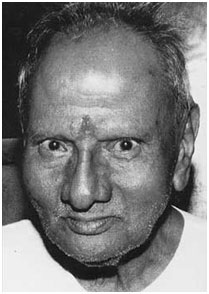
Another interesting point is that Maharaj did not incorporate any rigorous meditation training into his path. He was practicing in activity, in everyday life. If he did sit in meditation, it was done in moderation and mostly involved the contemplation of consciousness. Maharishi on the other hand, sat in deep meditation for twenty years. Therefore his energy naturally dropped more into being and the vertical dimension of his self was more awakened than that of Maharaj. It is possible to perceive a certain mystical element in Maharaj’s eyes, which indicates, that his state was not fully natural. Due to his extreme practice of disidentification, and to the fact that he did not sit, he developed consciousness that was too intense and lacked the vertical dimension. It is likely that mixing it with these mystical elements allowed him to cope with that intensity, because this helps to dilute the sense of me by ‘spacing it out’ thus making one less self-conscious of any energetic discomfort.

They were two different people, even if they were both connected to the energy of Shiva and Advaita. Maharishi was more in harmony with his human nature, more at peace and rest. Maharaj was living on the edge all his life; his was a path of intensity. Maharishi was a saint, for the good and for the bad. Maharaj was a rebel and spiritual revolutionary. He challenged the whole concept of spirituality, morality and sainthood in his total and absolute approach to transcendence.

Ramana and Maharaj were both great beings who deeply embodied the light of the self, while uncompromising serving through their very existence the revelation of truth. However, it comes as a surprise that in spite of their enormous spiritual capacity and intelligence, neither of them were able to embrace and understand the consciousness of me and decode the higher goal of our evolution beyond non-duality: the actualization of our soul. This only goes to show how deep human spiritual conditioning is. If these two beings could not transcend their conditioning, what can we expect from the average seeker? Perhaps their role was more to complete and end the era of Advaita. Since their deaths, no one has come even close to carrying this amount of light in the name of non-duality. Once upon a time, Advaita was a breakthrough revelation in human spirituality. But once this revelation was digested in the collective consciousness, it had served its purpose. Now it can be transcended. A new understanding must enter this dimension, a deeper revelation of truth, beyond the one-dimensional vision of spiritual evolution of non-duality. We have great love for Ramana and Maharaj, but it is time to move on. They gave us so much and they failed us so much too, by denying the existence of the soul. In their conditioned pursuit for self-knowledge, they missed the very essence of that knowledge – me.

Blessings, Aadi

For a definition of the terminology used, please visit the Glossary page. Click here for a printable version of this article.

Advaita – the Ruse of Shiva

shiva“Seldom, very seldom, does complete truth belong to any human disclosure; seldom can it happen that something is not a little disguised or a little mistaken.”

― Jane Austen

“There is nothing more deceptive than an obvious fact.”

― Arthur Conan Doyle

Unlike many of the teachings that originated in India, Advaita follows the lineage of Shiva. There are many aspects of god in Hindu mythology, but Shiva is the only true god of enlightenment and transcendence. He has never incarnated on earth in any form, but has entered our dimension through his revelations, which have been spoken through channels such as the teachings of Adi Shankara, the Shiva Sutras and the Yoga Vasistha. Shiva’s intention has always been to reveal the deepest dimension of enlightenment corresponding to humanity’s spiritual evolution at a particular time. Truth is fathomlessly deep, ever steeped in the transcendence of the known. It has countless layers, and can never show its magnificence fully, because that fullness is itself a flowering of never-ending unfoldment. For this reason, truth is only shown to us in accordance with our capacity to receive it. Humanity is lowly evolved and still deeply rooted in its ape ancestry, so the amount of truth it can handle is extremely limited. The gentle truth of the meaning of existence needs to be revealed gradually and in small portions. Too much truth at once can be detrimental – it can destroy the vessel which is supposed to contain it.

Shiva is the ultimate teacher. His responsibility is to reveal reality to those souls who have the capacity to create a conscious relationship with their creator. But he also has to take into account our ability to grasp that reality. Truth is absolute, but it is also relative. It is our relationship with truth that is relative, as it is defined by our level of evolution. Shiva has a complete understanding of human capability, and as such, he revealed only part of truth in the age of the Vedas and Upanishads, not the whole picture. At that time, there were very few conscious and spiritually mature seekers, and these few were only just beginning to open up to a singular dimension of awakening, one which was confined to the realization of impersonality. They were not yet ready to embrace the consciousness of higher individuality. Their contribution was, rather, to make the initial human attempts at laying the conceptual and experiential foundation of non-duality – the condition of non-separation from universal reality. However, even that realization of impersonal enlightenment was imperfect, as it can only become perfect through the knowingness of who actually attains non-duality – our individual self, the soul.

Having said this, the teaching of a separate soul and the concept of duality between the personal and universal is not entirely absent in Indian traditions. Non-duality is actually one of many streams of spirituality, and it is far from being the most influential. One of the great teachers who sought to find a balance between duality and non-duality was Ramanuja, who created the concept of qualified non-duality. From a certain standpoint, his teaching was conceptually more correct than the teaching of Shankara, because it affirmed the existence of soul and her unique identity within the state of unity with the supreme reality. However, the fact that he put concepts together in a more correct way does not mean that his understanding was deeper. The concept of ‘atman’ lacks even a basic understanding of what the soul actually is; atman is more the poetic idea of a finite entity given to us by birth, not dissimilar to the Christian concept of the soul. In truth, unless one goes through the complex process of soul-actualization, there is simply no soul to speak of – there is just ego.

So, even though Ramanuja and others spoke of the soul in positive terms, they did not know who the soul really is. They were not conscious of the basic fact that the soul has to come into existence through a long process of spiritual actualization in order to awaken to her relationship with the absolute reality. To perform bhakti (devotion) without having awakened one’s soul is pointless. One first of all has to be devoted to the evolution of one’s higher individuality, and only then can one express devotion to the supreme creator of all life.

Why did the revelation of Shiva not start with the soul, if she is closer to our personal existence? The answer is simple: there is no soul without transcendence. The soul comes into existence through the recognition and awakening of that aspect of our subjectivity which embodies the universal self – me. Our me has to surrender to the I am of the creator in order to give birth to her own higher self. Shiva did not mean to express non-duality as the absolute truth. He revealed it as the first level of truth, in order to test the capacity of humanity. The revelation of non-duality, of Advaita, was indeed Shiva’s most elaborate ruse, his ultimate challenge and greatest lesson.

The teaching of Advaita, though conceptually flawed, pointed much more deeply than other traditions to the realization of the impersonal self. Most of the devotional teachings in ancient India were connected to the energy of Vishnu, ‘the sustainer’ of creation. However, since our dimension of creation is also the dimension of illusion, there is an aspect of the primordial energy of Vishnu which aims at maintaining the state of illusion. Shiva, on the other hand, is the uncompromising destroyer of illusion. His path is of the transcendence and dissolution of the false self. He is not interested in sustaining the status quo, but in our death and spiritual rebirth in truth.

His purpose in revealing the teaching of Advaita was to test whether humanity would get stuck in the first step of his teaching, without the discrimination and inspiration to seek their unique individual existence. Would humans agree to live in the constrictions of non-duality, or would they have enough integrity to recognize the deeper meaning of his revelation? What was Shiva’s deeper revelation? To recognize from the core of our very existence and intelligence that, no matter how profound non-duality is, it is incomplete. It is as incomplete as a human body without a heart – it exists but it is not living.

Shiva said: “Now that I, the giver of creation and dissolution, have bestowed upon you the knowledge of non-duality, will you – or will you not – recognize the hidden, yet open, secret of higher duality? Will you be conscious, sensitive and lucid enough to acknowledge that something of tremendous value is missing from my original message? Something so precious that, in its absence, life is not worth living? If so, my beloveds in truth, will you then recognize that this secret is neither fully absent nor yet completely present within you? Will you identify that I have created each of you to be unique and to become, through your individualization, my inimitable reflection in the light of your me, quivering tenderly on the lotus flower of my creation? Those of you who have walked the path of impersonality have realized part of me; now go and realize your own soul. Only then can you really know me, for true knowledge is born out of the communion of knowing me and knowing yourself. It is for this purpose that, in the beginning of time, I gave you life. Your true self is the essence of divine individuality in the heart of my universal self. You are my child and I am your existence.”

Blessings, Aadi

For a definition of the terminology used, please visit the Glossary page. Click here for a printable version of this article.